
Skip to content
EnvyLeads IconEnvyLeads

AI Agent Development

AI Agent Development with Guardrails

We build AI agents that do useful, bounded work for Tucson organizations—with clear boundaries, human checkpoints, and defenses against common failure modes.

Software development team working together at a laptop

Goal and Boundary Definition

Every agent begins with a documented task, allowed inputs, expected outputs, and explicit non-goals. Tool and action allowlists, permissions, schemas, and approval gates are implemented as technical and operational controls, then tested for bypasses and failure modes. No control makes a model infallible, so actions outside the designed path are rejected, escalated, or placed into an exception workflow where the connected platform supports it.

Model, Tool, and Permission Selection

We choose models and tools based on your specific task, not on hype. We configure permissions at the least privilege level—the agent gets only the access it needs and nothing more. Data flow is mapped end-to-end, including retrieval sources, state management, and structured output schemas. We document every choice so your team understands what runs where.

Addressing Prompt Injection and Excessive Agency

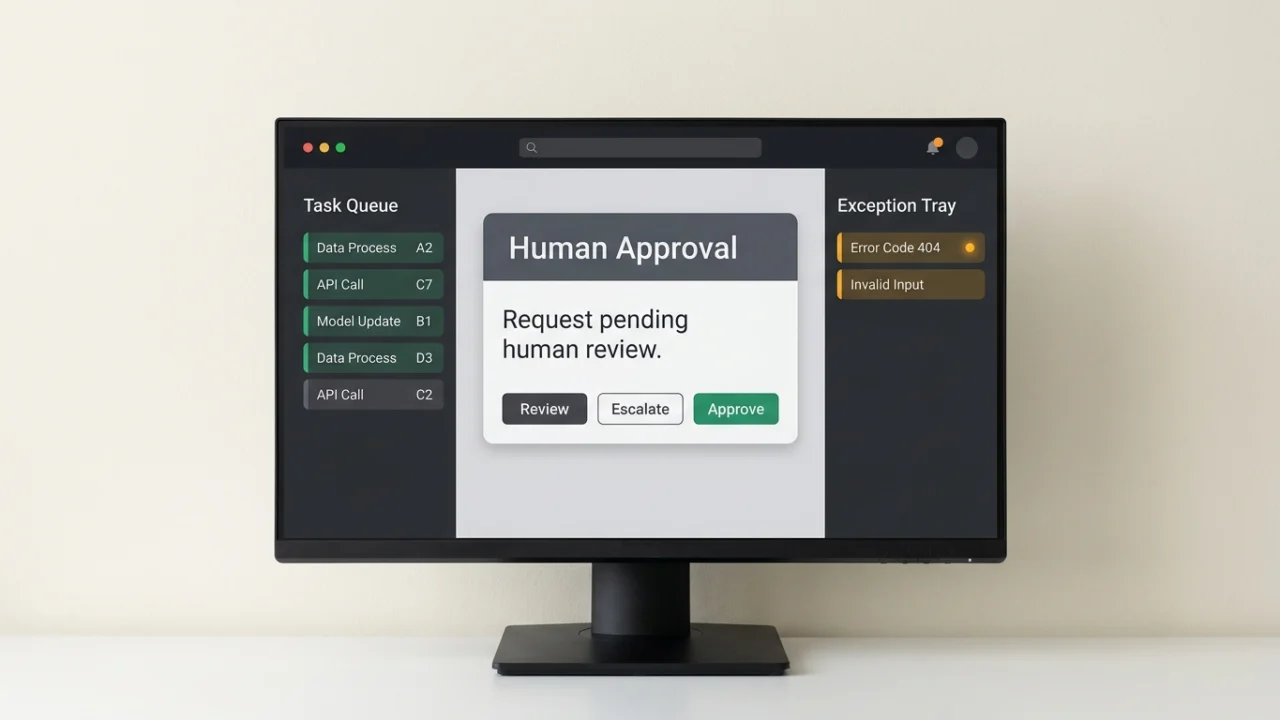
Prompt injection and untrusted context are treated as design risks rather than problems that a single prompt can solve. External content is separated from trusted instructions where possible, tools use scoped permissions, and outputs are validated before downstream use. High-impact actions require human approval. Evaluation includes adversarial cases, unauthorized-action attempts, unreliable outputs, and ambiguous inputs, with residual risks documented.

Evaluation, Logging, and Deployment

Evaluation cases are defined before release and rerun as prompts, models, tools, and data sources change. Logs capture the inputs, outputs, tool requests, approvals, exceptions, and system events available within the selected architecture; they do not expose hidden model reasoning. Deployment is staged with rollback and recovery procedures. Documentation covers monitoring, ownership, updates, access review, and retirement without claiming error-free operation.

What the engagement can produce

Practical deliverables

Agent Boundary and Goal Specification

A written definition of the agent's task, allowed actions, and explicit non-goals.

Tool and Permission Configuration

A detailed list of tools, data sources, and permission levels, with least-privilege rationale.

Prompt-Injection Defense and Approval Flow

Documentation of how the agent handles untrusted input, plus the human approval gates for high-risk actions.

Evaluation Set and Deployment Log

A test suite of representative cases, plus a deployment checklist and logging schema for ongoing monitoring.

Related AI solutions

Need a bounded AI agent?

Let's define the task, the boundaries, and the human checkpoints that keep it safe.

AI solutions decision guide

Is AI Agent Development Right for Your Business?

Start with the business problem and desired outcome. The consultation determines whether this service is the right next step, what should come first, and what does not need to be built.

Best fit

Who This Is For

A strong fit when a defined workflow involves repetitive language, research, classification or assistance—and the business can establish clear data, review and escalation boundaries.
Business outcome

What Should Change

A practical AI workflow with explicit inputs, outputs, oversight, evaluation and maintenance responsibilities instead of a novelty demo.

Scope control

What Happens First

We inspect the current process, define the constraint and agree on success criteria before recommending implementation.

A practical process

From Current Constraint to Working System

  1. 1

    Diagnose

    Review the goal, current workflow, available data and the point where progress breaks down.

  2. 2

    Define

    Agree on priorities, deliverables, responsibilities, measurement and the smallest useful scope.

  3. 3

    Implement

    Build or improve the approved components, test the handoffs and document ongoing ownership.

  4. 4

    Improve

    Review real performance, correct weak points and expand only when the evidence supports it.

Evaluate before you commit

Review the Work and the Method

Use the portfolio, case studies and results pages to inspect how Envy Leads approaches projects without relying on invented testimonials or unsupported promises.

Common questions

Before You Start AI Agent Development

What problems can this service help solve?

We begin with a real workflow and measurable acceptance criteria, then evaluate data, risk, human review, integrations and ongoing ownership.

Can Envy Leads work with our existing team and tools?

Yes. The first step is understanding what already works, who owns each part of the process and where the handoffs fail. Existing staff, vendors and systems can remain when they support the approved plan.

What happens after the free consultation?

You receive a clear recommendation for the next step. If implementation makes sense, scope, responsibilities and expected deliverables are defined before work begins.

Do we meet online or in person?

Choose a 20-minute online consultation or a 30-minute meeting at your location anywhere in Pima County. Appointments require at least 48 hours of notice.

Bring us the bottleneck

Talk Through AI Agent Development Before You Commit

Meet online, or have Envy Leads come to your location anywhere in Pima County.

A practical next step

Ready to turn more attention into customers?

Meet online, or we will come to your location anywhere in Pima County. Consultations are always by appointment.

Scroll to Top